Income that needs to last for decades rarely follows a straight line. It changes with markets, spending rules, and how uncertainty compounds over time. A strong average result can still produce a poor sequence of outcomes — especially when withdrawals are occurring throughout.
The order of returns, the level of volatility, and the rules governing payments all shape the income path an individual actually experiences. Averages alone don't capture that.
01
01
An approach can look good on average while producing very different outcomes when viewed year by year. The order of returns matters because income is experienced as a sequence of payments—not a summary statistic.
02
02
When income depends on markets, drawdowns have outsized effects because withdrawals occur while values are depressed. Recovery requires proportionally larger gains than the original loss — and higher volatility widens the range of possible outcomes even when the average return is unchanged.
03
03
Spending rules, floors, buffers, and pooling can smooth the income experience by limiting how much payments change. Other designs pass market movement through more directly. The Longevity Standard framework calls this structural feature the adjustment mechanism — what changes when conditions change. It's one of the most consequential differences between lifetime income arrangements, and it's often invisible until conditions actually move.
04
04
Income tends to feel stable when there are rules or guarantees that limit how much it can move. It can feel more volatile when it depends heavily on markets, changing spending, or one person’s lifespan. Most real-world approaches blend some stability with some flexibility.
05
05
Costs don’t seem important in a single year, but they add up over time. Even small ongoing fees can noticeably reduce income, especially in plans that depend on investment growth. Knowing the cost structure is a simple way to see how much of your money is working for you.
06
06
When people share longevity risk in a pool, no one has to personally set aside enough for the very longest lifetime. That can free up more income for everyone on average. The benefit comes from many people facing uncertainty together instead of each person trying to plan for every extreme on their own.
07
07
Rules—how much you put in, when you can take money out, how payouts are set, and whether risk is shared—can change outcomes just as much as investment returns. Two options with similar labels can work very differently once you see the rules. Understanding those rules is a key part of understanding the results.
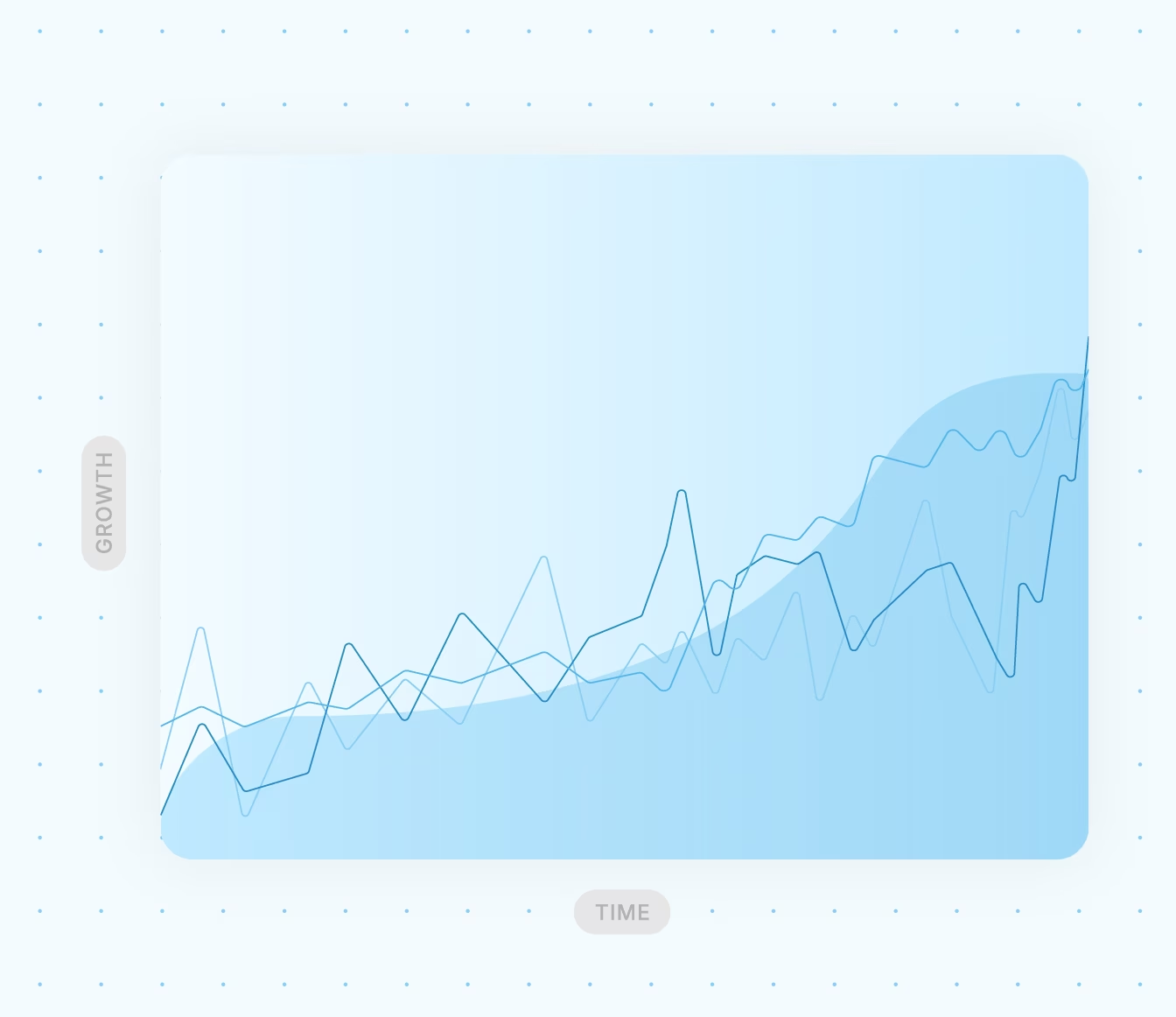
Most financial thinking talks in averages across many possible outcomes. But an individual lives one path through time. When you're drawing income, the order of gains and losses matters, and volatility can permanently change what an arrangement can sustain — even if the long-run average return looks fine on paper.
This insight has a name in the academic literature: ergodicity economics. It distinguishes between the ensemble average (the average across many possible paths) and the time average (what one individual actually experiences over their own lifetime). For lifetime income, the time average is what matters — because no individual gets to live many parallel lives. Two arrangements with identical expected returns can produce very different income paths depending on sequence, volatility, and the rules governing payments.