
How It Works
Start with the product. Establish the evidence. Investigate what matters.
LS Review begins with a real financial product and builds outward from there. We identify what is in front of us, determine what evidence actually applies, investigate how the product works, and turn that work into a Review you can inspect.
Step 01
Identify the product in front of us.
A Review can begin with an illustration, proposal, disclosure, contract, rider, or simply the product and issuer. The first task is establishing the specific product, version, terms, and obligations that matter in the case being reviewed.

Product

Issuer

Form

Rider

Jurisdiction

Relevant date
Step 02
Establish what actually applies.
A product name alone is not enough. Forms, versions, riders, jurisdictions, dates, and issuing entities can matter. Longevity Standard investigates the evidence needed to determine which terms and obligations belong to the product being reviewed.
Form

Version
Rider
Jurisdiction
Date
Issuing entity
Any one of these can change what the contract actually obliges.
Step 03
Build the evidence base.
Customer materials provide transaction-specific evidence. Longevity Standard adds independent, source-linked product and company research.
Transaction-specific evidence
Illustration
Proposal
Contract
Disclosure
Rider
Other case materials
Longevity Standard research
Product forms and versions
Company and legal-entity information
Ownership relationships
Source documents
Product terms and riders
Dated observations and events
LS Review is the independent interpretation of both.
Structured research
A growing research base makes each investigation stronger.
Longevity Standard maintains structured, source-linked information on financial institutions, products, forms, riders, versions, and other source-linked evidence that can be reused across Reviews.
What the base holds
Company record
Product record
Form and rider record
Source document
Dated observation
One specific LS Review
Each Review is specific to the product in front of us, but the research behind it does not start from zero.
The goal is not to produce a prettier summary. It is to establish what evidence actually belongs to the product being reviewed.
Step 04
Investigate how the product works.
The analysis follows the product from what is committed today to what may ultimately be delivered.
01
What is being promised?
02
What does the buyer give up?
03
What can reduce or constrain value?
04
What can change?
05
What conditions matter?
06
Who is responsible for delivery?
Step 05
Separate different kinds of findings.
Not every important question can be answered the same way.
Established
Supported by applicable evidence.
Guaranteed
Contractually fixed within the relevant scope.
Changeable
Subject to reset, discretion, future rates, or other adjustments.
Conditional
Dependent on elections, timing, behavior, or future conditions.
Unresolved
Important, but not yet established.
Step 06
Turn the investigation into a clear Review.
The final Review is designed to make the most important findings visible first, with the underlying evidence available where it matters.
- What the product commits to provide
- Key guarantees and changeable terms
- Important costs and restrictions
- Conditions that affect delivery
- Who stands behind the obligation
- What the evidence supports
- What remains unresolved
LS Review — method screen, live app
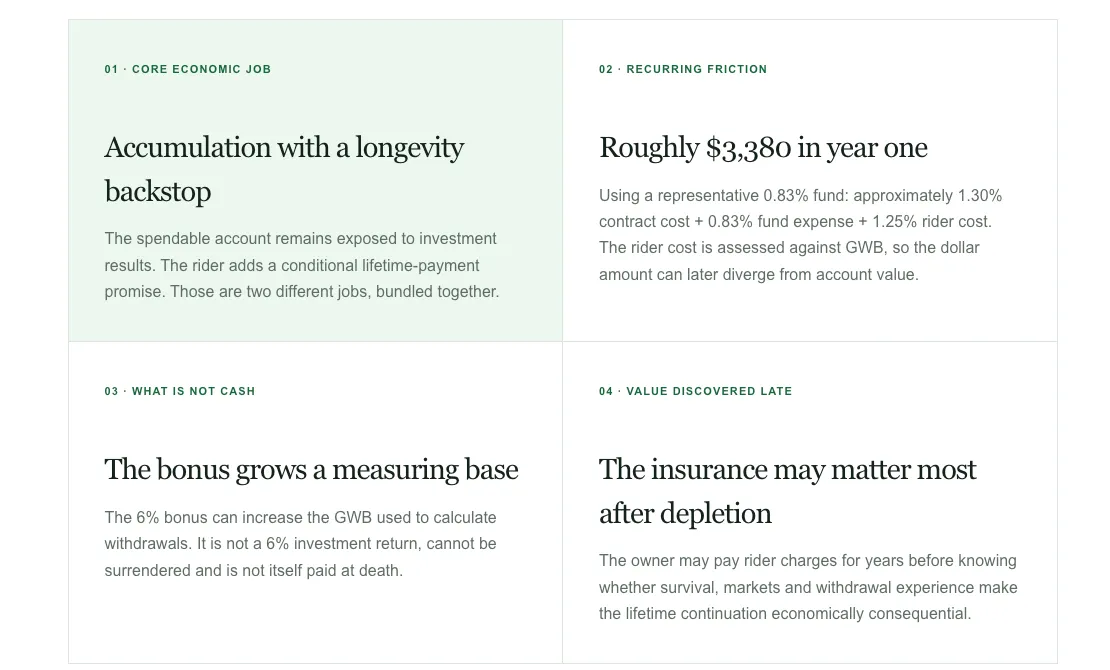
Fig. 01
Findings first, with the evidence kept within reach
The objective is not maximum information. It is useful understanding with traceable evidence behind it.
What If
Some questions cannot be answered by the product alone.
LS Review establishes the product, the terms, and the evidence. What If explores how changing future conditions could affect the value ultimately delivered.
Independence
The work is independent of the outcome.
Our economics are tied to doing the investigation.
Not which product is chosen.
Not how much is purchased.
Not whether a transaction takes place.
Start with the product in front of you.
Tell us what you are considering, or share the materials you received.